Period Problems in Korea: When Should You Visit an OB-GYN?
Irregular, painful, heavy or absent periods — a guide to getting help
Quick answer: See an OB-GYN in Korea if your periods are irregular for several months, so heavy you change protection every 1–2 hours, painful enough to disrupt daily life, absent for three months, or if you bleed between periods or after sex. Most period problems can be diagnosed with ultrasound and blood tests.
Periods can be affected by many things — stress, travel, new routines and changes in diet are all common when living abroad. Some period changes are temporary, but others deserve a medical check. Here's a guide to knowing when to visit an OB-GYN in Korea.
Irregular Periods
See a doctor if your cycles are regularly shorter than 21 days or longer than 35 days, or vary a lot month to month. Possible causes include PCOS, thyroid problems and hormonal changes.
Heavy Periods
Soaking through a pad or tampon every hour or two, passing large clots or bleeding for more than seven days can be signs of fibroids, polyps or hormonal issues — and can lead to anemia.
Painful Periods
Pain that stops you from working or studying, isn't relieved by painkillers or is getting worse over time may be a sign of endometriosis or adenomyosis.
Missed or Absent Periods
After ruling out pregnancy, missing three or more periods should be checked.
Bleeding Between Periods or After Sex
This should always be evaluated, especially if it persists.
Severe PMS
If mood changes before your period affect your relationships or work, treatment options are available.
What to Expect at the Clinic
- Questions about your cycle history — a period-tracking app helps
- Pregnancy test
- Pelvic exam and ultrasound
- Blood tests for hormones, thyroid and anemia
Treatment Options
Depending on the cause: pain relief, hormonal treatments, iron supplements, treatment for conditions like PCOS or fibroids, or lifestyle support.
Care in English
Period problems are personal. Discussing them with an English-speaking OB-GYN makes it easier to describe your symptoms accurately and understand your options.
Frequently Asked Questions
What period problems are most common?
Irregular periods, heavy bleeding, painful cramps and PMS are among the most common reasons women visit an OB-GYN.
Can period problems be treated without surgery?
Yes. Most are managed with medication, hormonal treatment or lifestyle changes.
Is it better to visit during or after my period?
For ultrasound and most consultations any time is fine; for a Pap smear, avoid booking during your period.
Related Guides
- Irregular Periods: When Should You See an OB-GYN?
- Heavy Periods: Causes, Diagnosis & Treatment
- Severe Period Cramps: When Is Menstrual Pain Not Normal?
- Bleeding Between Periods: When Should You See a Gynecologist?
- Complete Guide to Women's Healthcare in Korea for Foreigners
Book an English-Speaking OB-GYN Visit in Gangnam
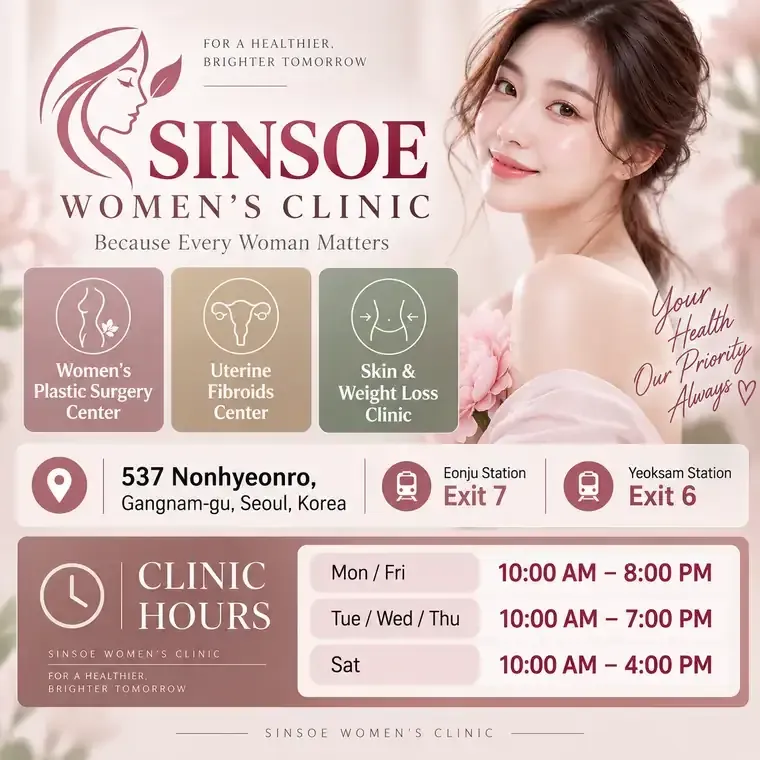
Sinsoe Women's Clinic is a female-led OB-GYN clinic at 537 Nonhyeon-ro, Gangnam-gu, Seoul, a short walk from Eonju Station (Line 9, Exit 7) and Yeoksam Station (Line 2, Exit 6). All physicians are female, board-certified OB-GYNs, and consultations are available in English. Message us on WhatsApp (+82-10-9517-5719) to book.
Hours: Mon & Fri 10:00–20:00 · Tue–Thu 10:00–19:00 · Sat 10:00–16:00 · Closed Sundays
This article is for general information only and is not a substitute for medical advice. Prices and procedures can change — please confirm details directly with the clinic.