STI Testing in Seoul: Tests, Costs & Confidential Care
Which tests to ask for, approximate costs and how privacy works
Quick answer: STI testing in Seoul can be done privately at an OB-GYN clinic in one visit, usually with a vaginal swab, urine sample and/or blood test for infections such as chlamydia, gonorrhea, trichomonas, mycoplasma, syphilis, HIV and herpes. Most results are ready within a few days, and visits are kept confidential.
Regular STI testing is a normal part of looking after your sexual health. In Seoul, testing is fast, accurate and confidential, and many clinics serve international patients in English. Here's what to know about the tests available, costs and privacy.

When Should You Get Tested?
- You have a new partner or multiple partners
- You or a partner have symptoms such as unusual discharge, burning, sores or pelvic pain
- A partner has been diagnosed with an STI
- You had unprotected sex or a condom broke
- As part of a routine checkup or before starting a new relationship
Common Tests
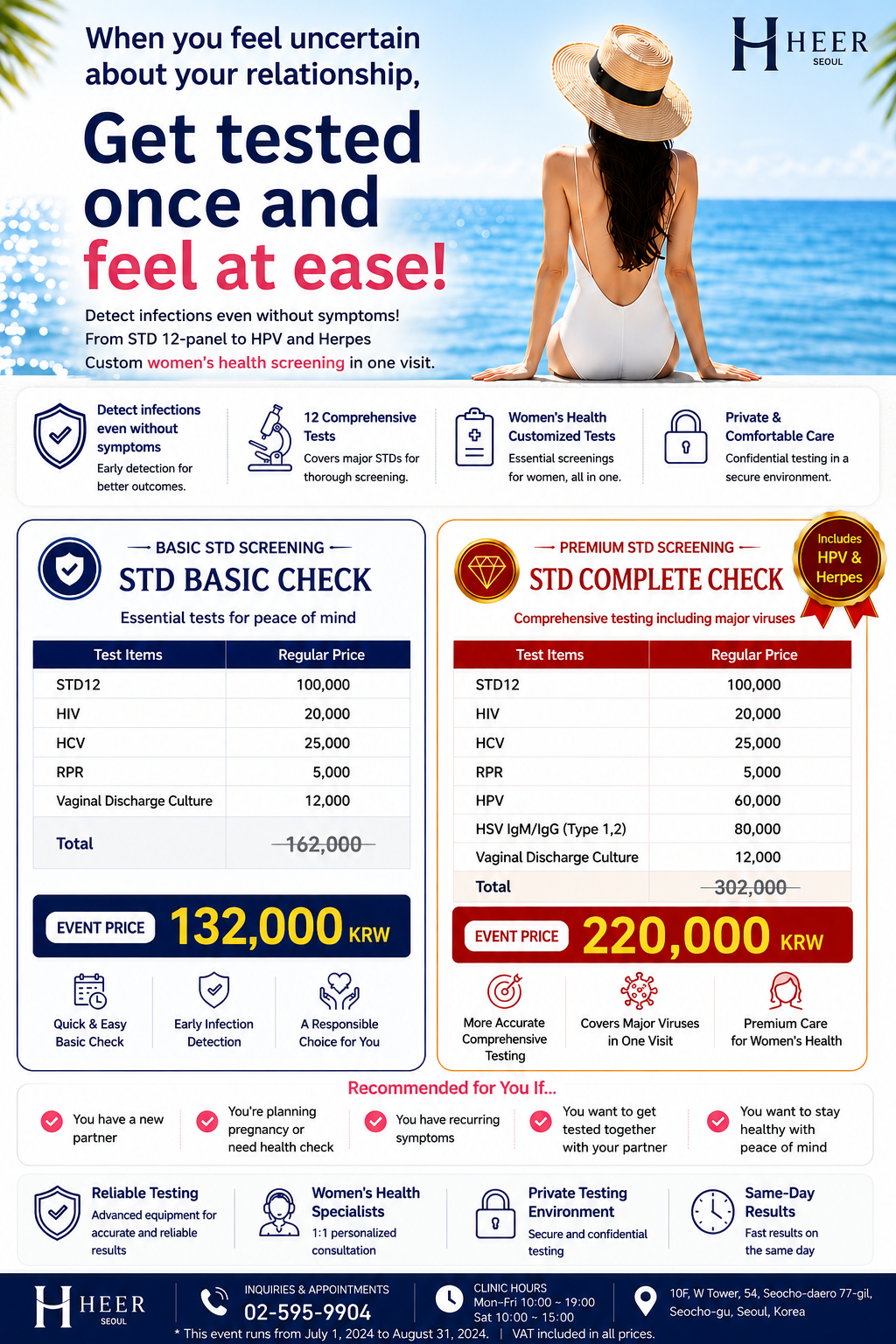
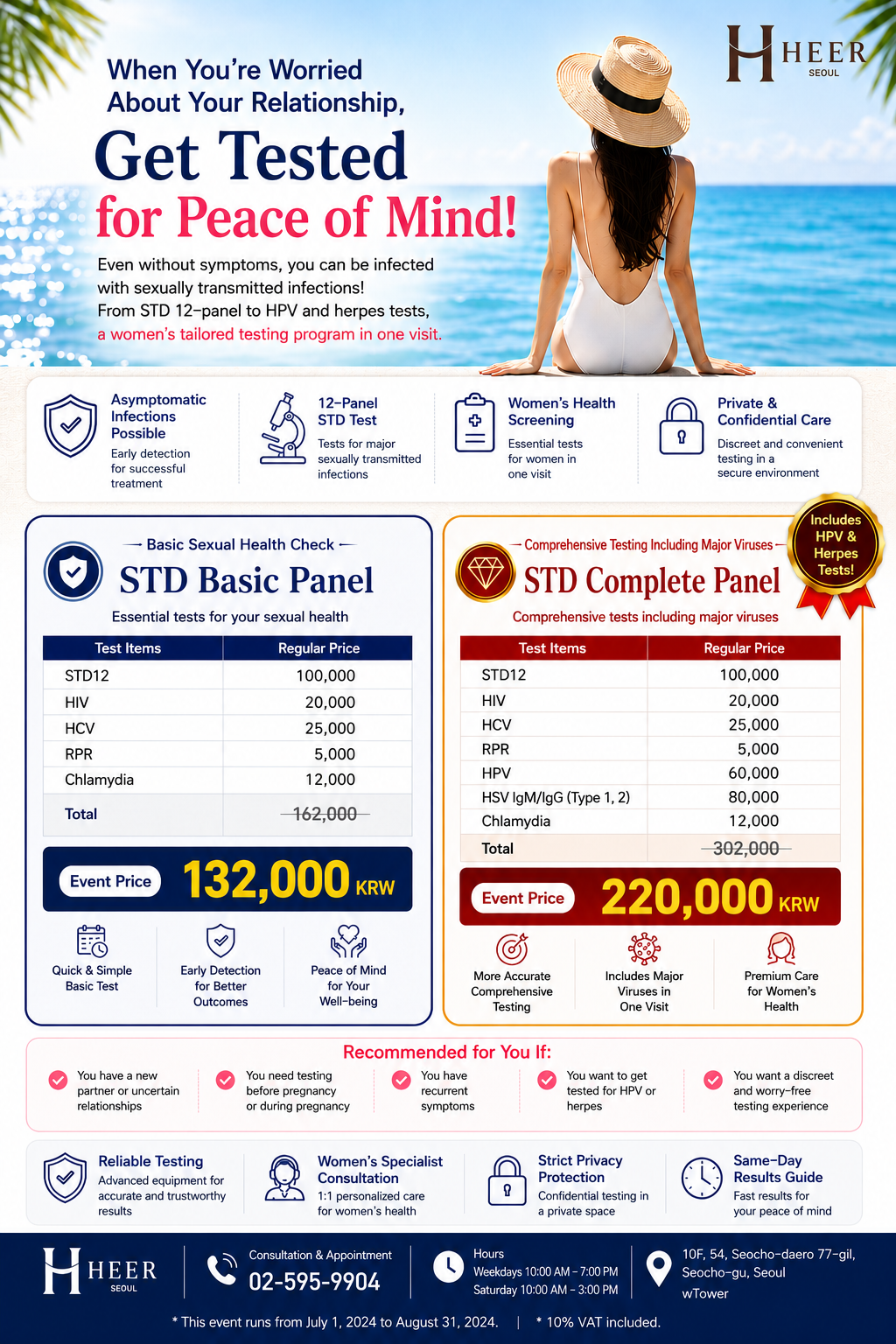
- Multiplex PCR panel: detects several infections from one vaginal swab or urine sample — commonly chlamydia, gonorrhea, trichomonas, mycoplasma and ureaplasma.
- Blood tests: for HIV, syphilis and hepatitis B or C.
- HPV test: for high-risk HPV types linked to cervical cancer.
- Herpes testing: usually a swab from an active sore.
Timing After Exposure
Some infections take time to become detectable. PCR tests for bacterial infections are often reliable about one to two weeks after exposure, while blood tests for HIV and syphilis may need to be repeated after several weeks. Your doctor can advise the best timing.
Approximate Costs
When testing is done without symptoms, it's usually paid out of pocket. As a rough guide, a multiplex PCR panel often costs around ₩100,000–200,000 depending on how many infections are included, with blood tests extra. If you have symptoms and NHIS coverage, some tests may be partly covered.
How Long Do Results Take?
PCR results typically take a few days. Some blood tests may be available sooner. Ask how results will be delivered — by message, phone or follow-up visit.
Confidentiality
Medical records in Korea are protected by privacy law. Clinics will not share your results with employers, schools or family. If privacy is a concern, ask the clinic how results are communicated and whether you can receive them in English.
If You Test Positive
Most bacterial STIs are cured with antibiotics. Your doctor will explain treatment, when to retest and how to inform partners.
Frequently Asked Questions
How soon after exposure should I get an STI test?
Some infections can be detected after about 1–2 weeks, while blood tests for HIV and syphilis may need several weeks; your doctor may suggest testing now and again later.
Can I get tested for STIs without symptoms?
Yes. Many STIs cause no symptoms, so testing is recommended after a new partner or unprotected sex.
Will my STI test results stay private in Korea?
Yes. Medical information is protected by law, and results are shared only with you.
Related Guides
- STD Testing in Gangnam: A Foreigner's Guide
- Chlamydia Testing and Treatment in Korea
- Herpes Testing in Korea: Symptoms, Diagnosis & Treatment
- Private & Confidential OB-GYN Care in Korea for Foreign Women
- Complete Guide to Women's Healthcare in Korea for Foreigners
Book an English-Speaking OB-GYN Visit in Gangnam
Sinsoe Women's Clinic is a female-led OB-GYN clinic at 537 Nonhyeon-ro, Gangnam-gu, Seoul, a short walk from Eonju Station (Line 9, Exit 7) and Yeoksam Station (Line 2, Exit 6). All physicians are female, board-certified OB-GYNs, and consultations are available in English. Message us on WhatsApp (+82-10-9517-5719) to book.
Hours: Mon & Fri 10:00–20:00 · Tue–Thu 10:00–19:00 · Sat 10:00–16:00 · Closed Sundays
This article is for general information only and is not a substitute for medical advice. Prices and procedures can change — please confirm details directly with the clinic.