Hormone Replacement Therapy (HRT) in Korea: Benefits & Considerations
Who HRT may help, the main types and the risks to discuss with your doctor
Quick answer: Hormone replacement therapy (HRT) replaces estrogen, often with progestogen, to relieve menopause symptoms such as hot flashes, night sweats and vaginal dryness, and helps protect bone density. In Korea it is prescribed by OB-GYNs after a health review, and the type and dose are tailored to you.
Hormone replacement therapy (HRT) — also called menopausal hormone therapy — can greatly relieve menopausal symptoms. But it isn't right for everyone. Here's a balanced look at the benefits, risks and options available in Korea.

What Is HRT?
HRT replaces the estrogen your body produces less of after menopause. Women who still have a uterus also take a progestogen to protect the uterine lining.
Potential Benefits
- Relief from hot flashes and night sweats
- Better sleep and mood for many women
- Reduced vaginal dryness
- Protection against bone loss and fractures
Types of HRT
- Estrogen-only: for women who have had a hysterectomy
- Combined estrogen and progestogen: for women with a uterus
- Forms: tablets, skin patches or gels; the form can affect risks
- Local vaginal estrogen: low-dose treatment for vaginal and urinary symptoms
Risks to Discuss
- A small increase in the risk of blood clots and stroke, particularly with tablets
- A small increase in breast cancer risk with longer-term combined HRT
- Side effects such as breast tenderness, bloating or spotting, especially at first
For many healthy women under 60 or within about 10 years of menopause, the benefits may outweigh the risks — but this is an individual decision.
Who Should Avoid HRT?
HRT may not be suitable if you have a history of breast cancer, blood clots, stroke, liver disease or unexplained vaginal bleeding. Your doctor will review your history carefully.
Before Starting
- Medical and family history review
- Blood pressure check
- Breast and cervical screening as appropriate
- Discussion of your goals and preferences
Ongoing Monitoring
Regular reviews — often after three months and then yearly — help ensure HRT is still right for you and at the lowest effective dose.
Frequently Asked Questions
Who should not take HRT?
Women with a history of breast cancer, blood clots, stroke, active liver disease or unexplained vaginal bleeding are usually advised against HRT.
What types of HRT are available?
Options include tablets, patches, gels and local vaginal estrogen, with or without progestogen.
How often should I be checked on HRT?
Usually after a few months and then at least yearly, including breast and other recommended screening.
Related Guides
- Menopause Treatment in Korea: A Guide for Foreign Women
- Women's Health Screening by Age: Your 20s, 30s, 40s & 50s
- Bleeding Between Periods: When Should You See a Gynecologist?
- Women's Health Checkup in Seoul: A Guide for Foreigners
- Complete Guide to Women's Healthcare in Korea for Foreigners
Book an English-Speaking OB-GYN Visit in Gangnam
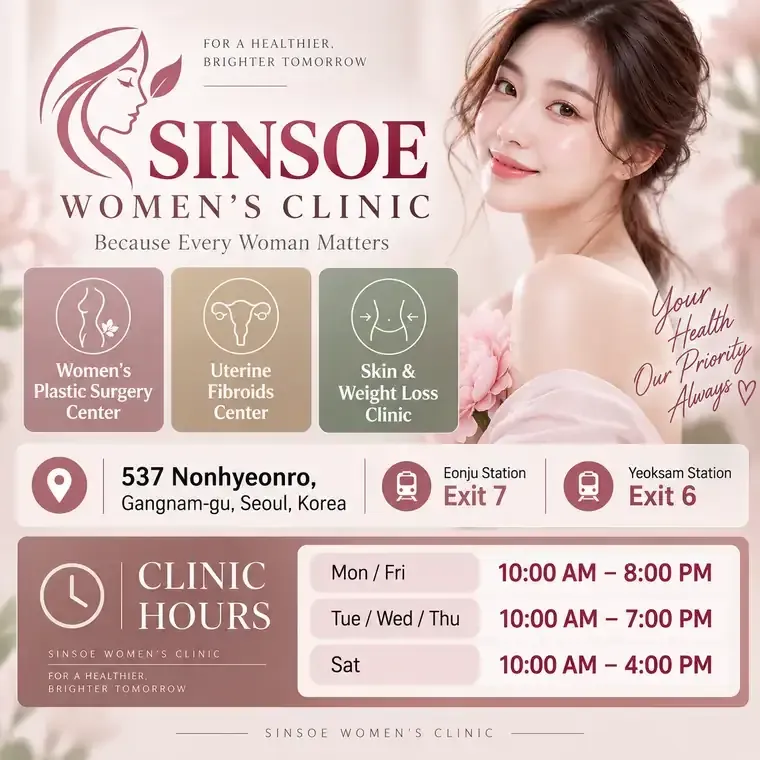
Sinsoe Women's Clinic is a female-led OB-GYN clinic at 537 Nonhyeon-ro, Gangnam-gu, Seoul, a short walk from Eonju Station (Line 9, Exit 7) and Yeoksam Station (Line 2, Exit 6). All physicians are female, board-certified OB-GYNs, and consultations are available in English. Message us on WhatsApp (+82-10-9517-5719) to book.
Hours: Mon & Fri 10:00–20:00 · Tue–Thu 10:00–19:00 · Sat 10:00–16:00 · Closed Sundays
This article is for general information only and is not a substitute for medical advice. Prices and procedures can change — please confirm details directly with the clinic.